
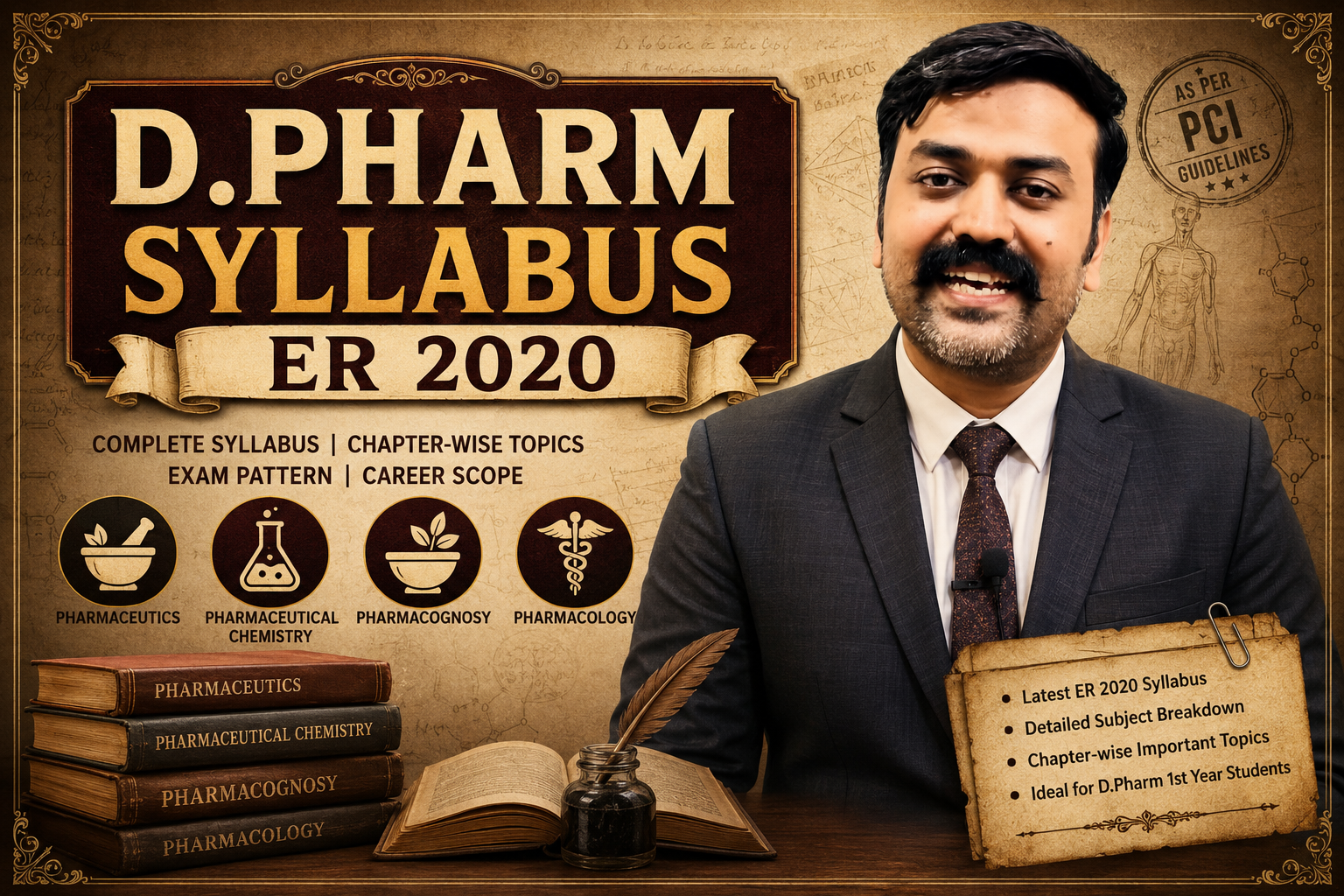
The Diploma in Pharmacy (D.Pharm) is one of the most popular pharmacy courses in India for students aspiring to become registered pharmacists or build a career in the pharmaceutical industry. The Pharmacy Council of India (PCI) introduced the Education Regulations (ER)-2020 to modernize pharmacy education by replacing the older ER-1991 curriculum. The ER-2020 syllabus focuses on competency-based education, practical skills, patient care, communication, community pharmacy, and clinical knowledge. It is a two-year diploma program followed by mandatory practical training, ensuring students are prepared for real-world pharmacy practice. The curriculum includes theory classes, laboratory practicals, tutorials, and experiential learning to develop professional competencies.
The D.Pharm ER-2020 syllabus is divided into First Year and Second Year, covering a balanced combination of pharmaceutical sciences and healthcare subjects. The first year builds a strong foundation with subjects such as Pharmaceutics, Pharmaceutical Chemistry, Pharmacognosy, Human Anatomy & Physiology, and Social Pharmacy. In the second year, students study Pharmacology, Community Pharmacy & Management, Biochemistry & Clinical Pathology, Pharmacotherapeutics, Hospital & Clinical Pharmacy, and Pharmacy Law & Ethics. Along with classroom learning, students perform laboratory experiments, case studies, prescription analysis, patient counselling, and community health activities to strengthen their practical skills. The ER-2020 curriculum also emphasizes communication skills, ethics, public health, rational use of medicines, and patient safety, making graduates industry-ready and healthcare-oriented.
One of the biggest advantages of studying under the PCI ER-2020 syllabus is its strong focus on employability and professional development. Students receive hands-on exposure through practical training in hospitals and community pharmacies, enabling them to understand drug dispensing, medication counselling, inventory management, and pharmaceutical care. After completing D.Pharm, graduates can register as pharmacists (subject to applicable regulations) and pursue careers in retail pharmacies, hospitals, pharmaceutical manufacturing, quality control, medical sales, regulatory affairs, and government healthcare services. Many students also continue their education through B.Pharm, opening doors to research, higher studies, and advanced career opportunities. With India’s pharmaceutical sector growing rapidly, the D.Pharm ER-2020 curriculum provides the knowledge and practical experience needed for long-term success in the healthcare industry.
Download Link https://www.pci.nic.in/pdf/14-55_circular_23062021.pdf
D.Pharm ER-2020 Course Highlights
| Feature | Details |
|---|---|
| Course Name | Diploma in Pharmacy (D.Pharm) |
| Regulatory Body | Pharmacy Council of India (PCI) |
| Curriculum | Education Regulations (ER)-2020 |
| Duration | 2 Years + Mandatory Practical Training |
| Course Type | Diploma |
| Learning Mode | Theory, Practical, Tutorials & Training |
| Objective | Develop competent pharmacists for healthcare and pharmaceutical industries |
D.Pharm ER-2020 First Year Subjects
| Subject | Major Topics Covered |
|---|---|
| Pharmaceutics | Prescription, dosage forms, dispensing pharmacy, packaging |
| Pharmaceutical Chemistry | Inorganic and Organic Pharmaceutical Chemistry |
| Pharmacognosy | Medicinal plants, crude drugs, herbal medicines |
| Human Anatomy & Physiology | Human body systems and physiological functions |
| Social Pharmacy | Public health, health education, disease prevention |
D.Pharm ER-2020 Second Year Subjects
| Subject | Major Topics Covered |
|---|---|
| Pharmacology | Drug classification, mechanism of action, adverse effects |
| Community Pharmacy & Management | Pharmacy services, inventory management, patient counselling |
| Biochemistry & Clinical Pathology | Clinical laboratory tests, metabolism, disease diagnosis |
| Pharmacotherapeutics | Drug treatment of common diseases |
| Hospital & Clinical Pharmacy | Hospital pharmacy practice, prescription review, ADR monitoring |
| Pharmacy Law & Ethics | Drugs & Cosmetics Act, Pharmacy Act, professional ethics |
Top 10 Features of D.Pharm ER-2020 Syllabus
- Designed by the Pharmacy Council of India (PCI).
- Based on competency-based education.
- Strong emphasis on practical learning and laboratory work.
- Includes community pharmacy and patient counselling.
- Covers clinical pharmacy and hospital pharmacy concepts.
- Introduces professional ethics and legal aspects of pharmacy.
- Focuses on rational use of medicines and patient safety.
- Includes mandatory practical training for real-world experience.
- Enhances communication and professional skills.
- Prepares students for government jobs, hospital pharmacy, retail pharmacy, pharmaceutical industry, and higher education.
Career Opportunities After D.Pharm
| Career Option | Typical Entry-Level Salary (India) |
|---|---|
| Community Pharmacist | ₹2.5–4.5 LPA |
| Hospital Pharmacist | ₹3–5 LPA |
| Medical Representative | ₹3–6 LPA |
| Production Executive | ₹3–5.5 LPA |
| Quality Control Analyst | ₹3–6 LPA |
| Government Pharmacist | As per state/central government pay scales |
| Continue to B.Pharm | Better long-term career growth |